The Missing Link in Local SEO: How Virtual Tours Give Your Clients the Edge
Executive Summary: How do virtual tours support the work agencies do in local SEO? Professional 360 degree virtual tours are a high impact visual asset that agencies can use to increase user dwell time and build brand trust. While Google retired the official Street View Trusted badge in late 2024, the professional photographers who built the programme remain the most effective way for agencies to drive engagement and physical foot traffic for their clients.
I have spent years working alongside agencies to integrate Local SEO virtual tours into their broader mapping strategies. I know the drill: you spend your days perfecting the Google Business Profile (GBP), chasing reviews, and refining categories. However, there is a significant opportunity that I see many agencies overlooking. There is a massive gap in the visual layer of the profile that, when filled, builds immense trust and drives the physical foot traffic your clients are looking for.
For over a decade, the Google Street View Trusted programme was the benchmark for high end business imagery. It consisted of a global network of professionals trained to capture high resolution, 360 degree virtual tours. According to data from the official Local Guides Connect community, there were exactly 25,588 Street View Trusted Photographers engaged with the platform at the peak of the programme. The actual number of virtual tour specialists is likely well over 30,000 since many did not participate in the Local Guides community.
As I noted when the programme began shutting down in late 2024, Google’s decision to retire the “Trusted” badge did not remove the need for professional quality. In fact, it created a vacuum. While anyone can now upload a basic 360 photo, the difference between a standard user upload and a professional virtual tour is often the difference between a lead and a bounce.
Why Professional 360 Imagery is a Critical Signal
High quality, intentional 360 imagery acts as a powerful engagement signal that helps your SEO work perform better.
Dwell Time: When a user enters a virtual tour, they stay on your client’s listing longer. This increased behavioural signal tells Google the listing is relevant and useful.
Trust and Transparency: For many industries, the “unknown” is a barrier to booking. A virtual tour provides a 24/7 open house that removes friction before a customer even leaves home.
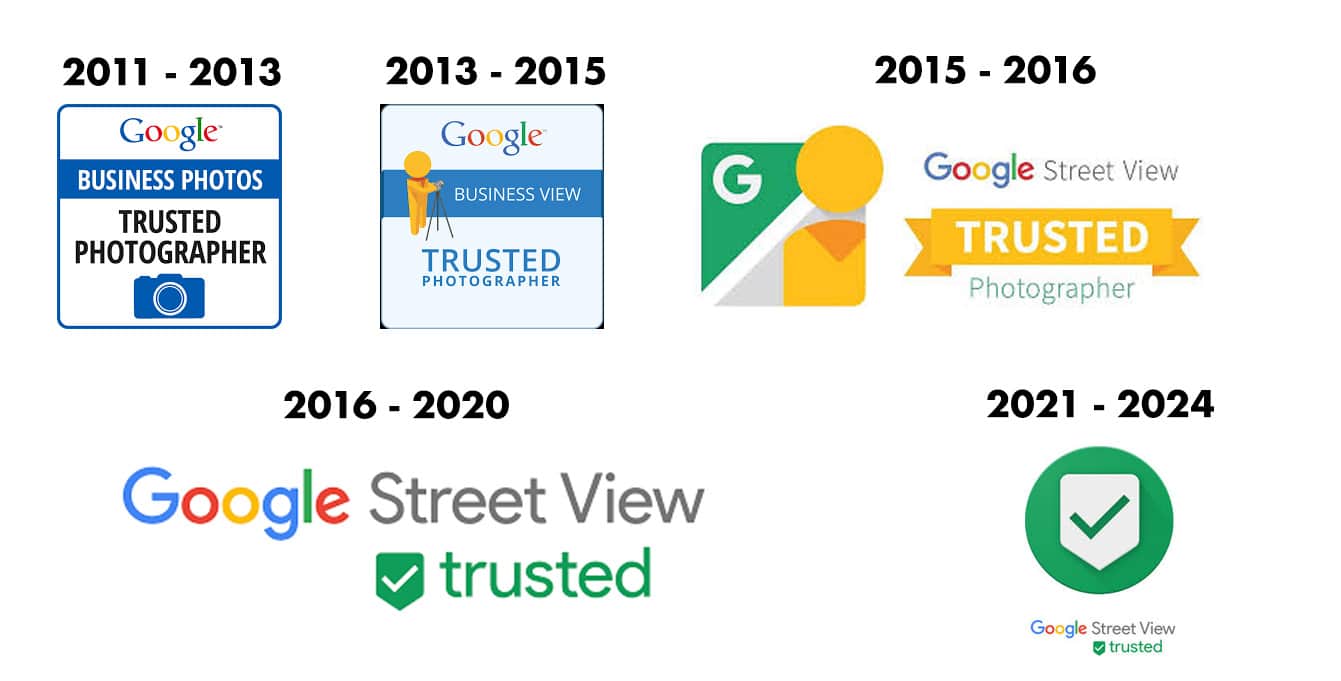
Display of the history of Google’s affiliation logos for professional photographers from inception in 2011 through to program closure in 2024
Visual Verification in an AI World
Trust is becoming the web’s most valuable currency as AI generated content becomes more common. While emerging industry standards like the Content Authenticity Initiative (CAI) are beginning to address “verified” flat images, 360 degree media is still catching up. Until those technical standards are fully integrated, a professional virtual tour remains the most authentic “proof of presence” a business can provide. It offers a level of environmental verification that is nearly impossible to fake, giving both users and search algorithms a high trust signal that the premises are real and precisely as described.
Unlike standard photos where metadata is stripped upon upload to a Google Business Profile, 360 degree imagery is a special case. These images must be tied to specific coordinates to appear correctly on the map and within the virtual tour. This creates a verified, hard coded link between the visual content and the physical location. For a Local SEO specialist, this provides a level of location proof that standard images simply cannot offer.
High-Trust Verticals: Health, Education, and Care
To provide real value to your clients, it helps to understand which industries benefit most from a professional visual strategy. Although this is far from a complete list, here are the high-trust sectors where 360 tours move the needle:
Medical and Allied Health (Dentists, Physios, GPs): Patients often feel anxious about new environments. Seeing a clean, professional clinic reduces that friction and builds rapport before they even book. It is about “patient comfort” as much as it is about marketing.
Aged Care and NDIS Providers: Choosing a facility for a loved one is a high stakes emotional decision. A tour allows families to explore the safety, cleanliness, and layout of a facility at their own pace.
Education and Early Learning: Parents want to see where their children will be spending their day. From childcare centres to private schools, a virtual tour provides the transparency required to build parental trust.
Consumer Verticals: Hospitality, Retail, and Lifestyle
In the consumer space, the goal is to set expectations and sell the “vibe” of the location:
Restaurants and Hospitality: Diners want to “feel” the atmosphere and see the layout. Is it intimate for a date? Is it family friendly? A tour answers these questions instantly.
Hotels, Motels and Accommodation: One of the industries that “need” virtual tours the most but often overlook it is accommodation. Everyone who has travelled knows what it’s like to arrive at a room and be disappointed. You can help fix that!
Event Venues and Function Spaces: Brides and event planners need to understand the flow of a space. A 360 tour is essentially a 24/7 site inspection that saves them hours of physical travel.
Retail and Showrooms: Allowing customers to browse the aisles virtually can bridge the gap between online research and an in person visit. This is particularly effective for high end boutiques or specialty hobby shops.
Car Dealerships: High value purchases require high trust. Letting a customer “walk” the showroom floor and see the latest models from home is a powerful conversion tool.
Gyms and Wellness Centres: Potential members want to see the equipment, the change rooms, and the overall “vibe” before committing to a membership. This is currently one of my biggest verticals.
Industrial and B2B Visual Strategy
Industrial and Manufacturing: For B2B clients, showing the scale of a workshop or the cleanliness of a manufacturing plant can be the deciding factor in a major contract.
Commercial Real Estate: Corporate leasing is a different game to residential sales. Large office floors and vast warehouses require the superior dynamic range and clarity of professional DSLR gear to properly represent the asset to high value corporate tenants.
Accessibility Matters: Inclusion Through Virtual Tours
Remember that virtual tours are also a critical part of helping people with physical disabilities. If a potential customer cannot see how steep a wheelchair ramp is or how far disabled parking is from the front door, that is a whole segment of the population you have alienated. Including a virtual tour is a simple way to do the right thing and ensure your clients are being as inclusive as possible.
The Technical Advantage: Why Your Clients Need a Pro
While any photo is better than none, there is a profound difference between a standard snapshot and a conversion centric 360 tour. A professional brings an eye for detail that automated tools simply cannot match.
I often advise caution when relying on residential real estate tools like Matterport for these commercial tours. While those tools have their place—primarily in selling residential real estate and some limited commercial spaces—they are often LiDAR driven and frequently struggle with outdoor shots, high traffic environments, and moving people.
A true 360 pro uses specialised DSLR or mirrorless gear to ensure high quality HDR results. We understand how to manage complex lighting, obtain model releases, and ensure that every person or number plate is correctly blurred for privacy and compliance when appropriate.
How to Measure the ROI for Your Clients
To prove the value of this service to your clients, you can use the Performance tab in the GBP manager:
Baseline: Note the average monthly “Photo views” and “Website clicks” before the tour is published.
Implementation: Have a professional upload the tour and high quality stills.
Analysis: Monitor the “Business Profile interactions” over the following three months. You will typically see a significant lift in both the number of views and the length of time users spend interacting with the profile.
For 360° Photos: Many virtual tour photographers also have access to the 360 photo stats which are not included in the standard photo view counts. That data sits inside the Google Maps “Street View” data bucket, but we can help you access that information if you ask for it.
Where the Professionals are Hiding
Since Google no longer maintains a public directory, you have to be more strategic in finding the right talent to partner with:
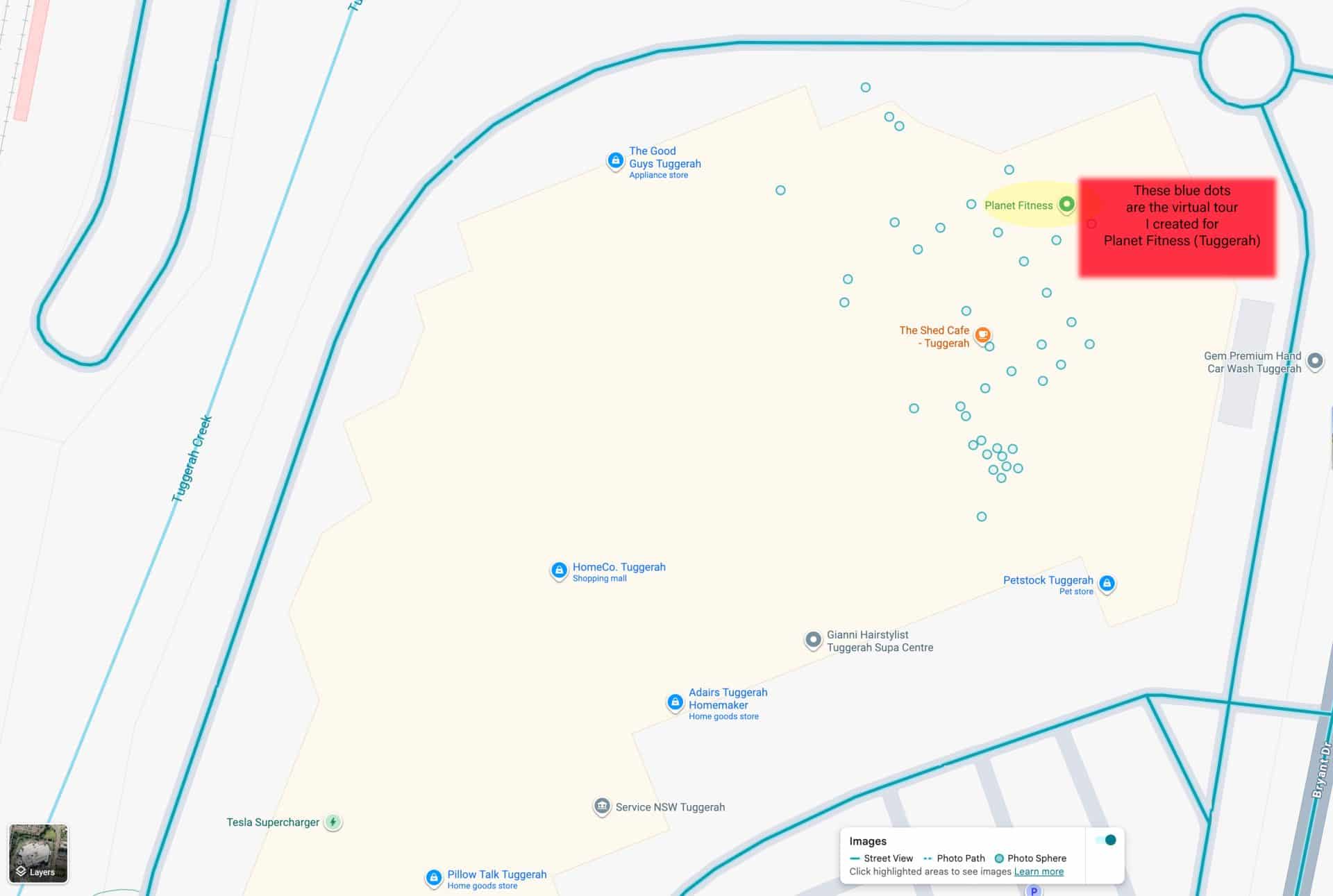
The “Blue Dot” Method:Open Google Maps and look at a business building. If you see a cluster of blue dots rather than a blue line, that is a virtual tour. Click a dot to enter the tour and look at the attribution name in the corner. If the work is recent and high quality, you have found an active pro.
The IVRPA: The International Virtual Reality Photography Association is where the top tier 360 specialists list themselves.
LinkedIn Vetting: Look for photographers on LinkedIn who specifically mention shooting virtual tours for business. While some residential real estate photographers cross over, you will need to vet their commercial portfolio carefully.
Partnering for Better Local SEO Results
Partnering with a 360 photographer opens up new revenue streams for your agency. We can work together to build custom overlays with “hotspots.” These are clickable links within the tour that lead to specific product pages or booking forms. For an SEO agency, this creates a wealth of new, high value site pages for you to manage and optimise.
I am deeply involved in this professional community here in Australia. If you have clients near me, I can assist your agency directly. If they are further afield, I am happy to provide a referral to a trusted colleague in your specific area who understands the standards required for high end local SEO.